
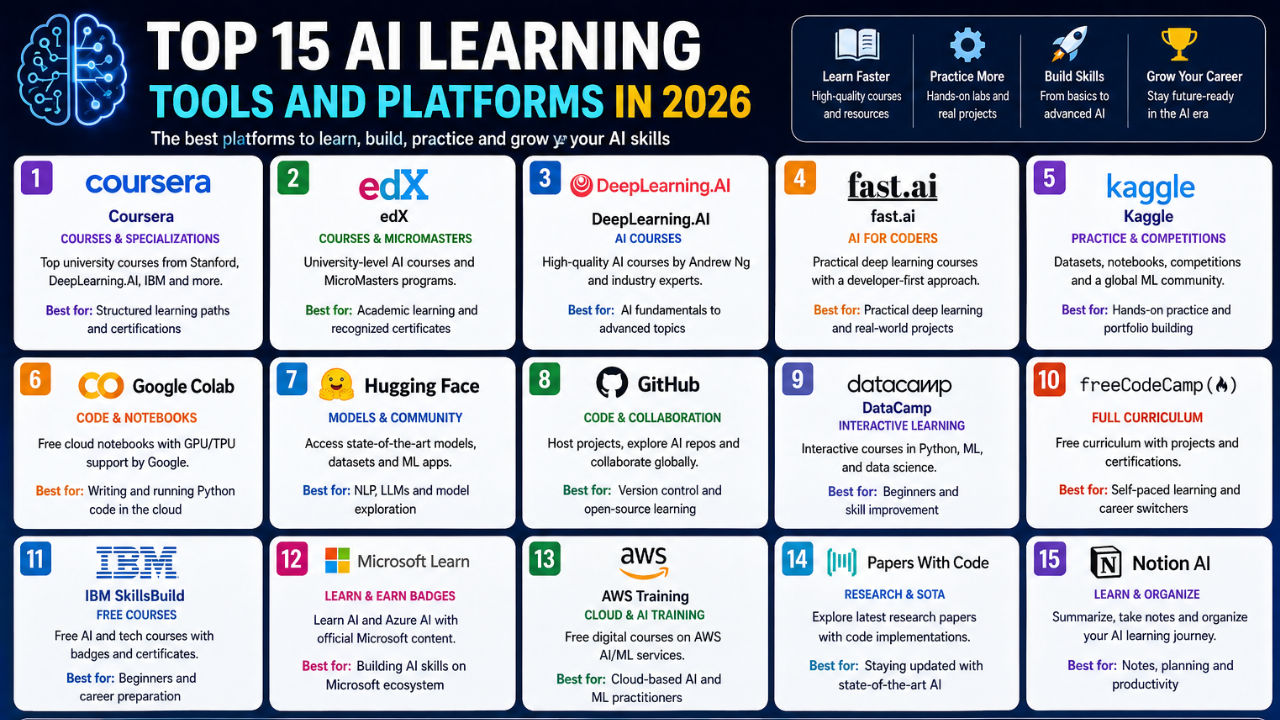
Top 15 AI Learning Tools and Platforms in 2026.From courses to code editors, these are the platforms that genuinely move learners from beginner to job-ready in the AI field this year.
The number of AI learning tools released in the past two years is genuinely overwhelming. Many are excellent. Many are noise. After testing dozens of them with our own students and readers, this is the shortlist that earns its place in 2026.
Free Course Platforms
- fast.ai — Jeremy Howard’s deep-learning courses remain the most underrated entry point. Practical, project-driven, and free.
- Coursera (Andrew Ng’s specialisations) — the Machine Learning Specialization and Deep Learning Specialization are slower-paced but extremely thorough.
- Hugging Face Learn — the NLP, audio, and reinforcement-learning courses are short, focused, and use real production tools.
- DeepLearning.AI Short Courses — one to two-hour courses on specific topics like prompt engineering, LangChain, and RAG.
Hands-on Coding Environments
- Google Colab — free GPU access in the browser. Still the easiest place to run your first notebook.
- Kaggle Kernels — like Colab, but tied to datasets and competitions you can actually enter.
- Hugging Face Spaces — deploy a working demo of your model in minutes, share it with a link.
Foundational Libraries Worth Learning Deeply
- PyTorch — the dominant research framework. If you intend to read papers, learn this first.
- scikit-learn — for everything that is not deep learning. Underrated by beginners who jump straight to neural networks.
- Hugging Face Transformers — pretrained models for almost any text, vision, or audio task, available in a few lines of code.
Productivity & Practice Tools
- Cursor / VS Code with Copilot — AI-assisted editors that genuinely speed up your learning by explaining unfamiliar code as you read it.
- Anki — the boring spaced-repetition flashcard app that, used daily, will make formulas and terminology stick.
- Papers With Code — every important paper paired with its open-source implementation. Reading code is faster than reading papers.
- arXiv Sanity — filtered preprint feeds so you do not drown in 500 papers a day.
- Discord communities — the EleutherAI and Hugging Face servers are where serious learners actually ask questions.
How to Use This List
Do not subscribe to all fifteen. Pick one course, one coding environment, and one community. Stay with that combination for at least eight weeks before adding anything else. Tool-hopping is the most common reason promising learners stall.
A Word on Paid Tools
Most paid certificates do not get you hired. A public GitHub with three working projects does. Spend money only on tools that save you time — a good GPU rental for a few weekends, perhaps, or a single book that compresses years of practitioner experience.
Follow on Facebook