How to Build a Career in AI: A Realistic 2026 Roadmap. A grounded look at the paths into AI work in 2026, the skills that actually open doors, and the common detours that waste years.
Building a career in AI in 2026 is both easier and harder than it was five years ago. Easier because the tooling is dramatically better. Harder because the bar for entry-level practitioners has risen as the field matures. This roadmap is the version we wish someone had given us, written for people starting today.
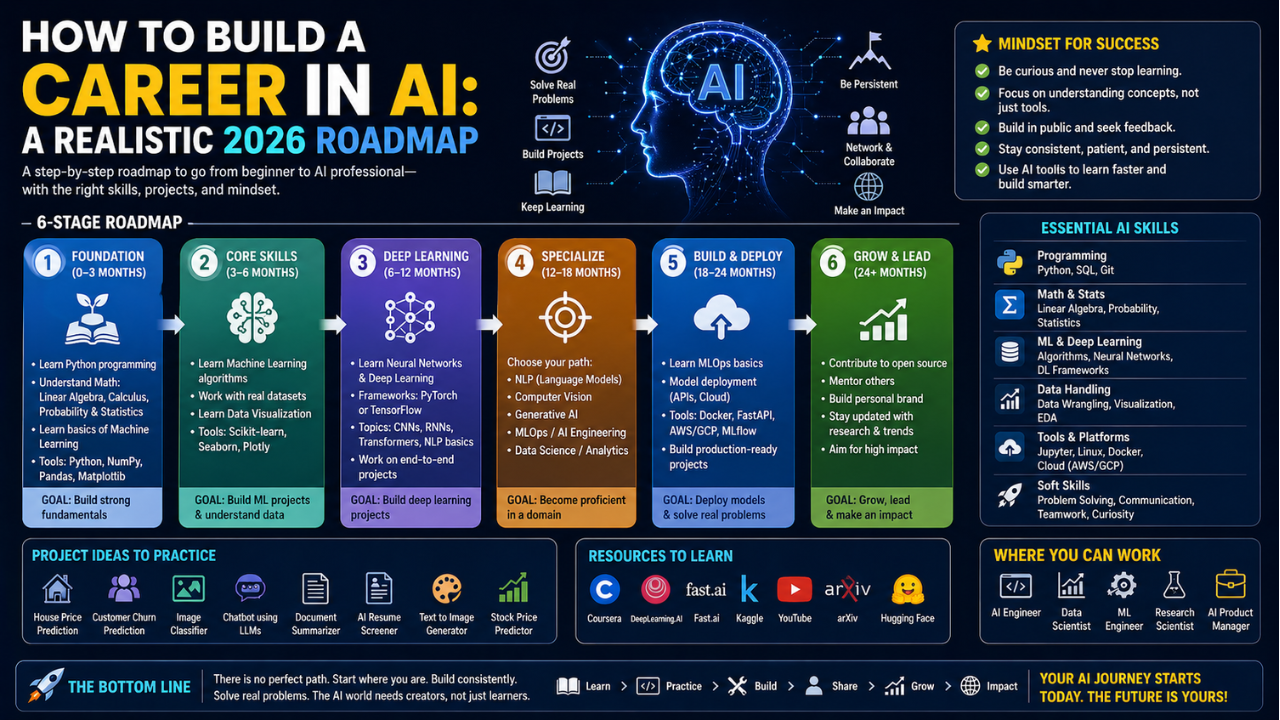
The Common Roles, Demystified
- Machine Learning Engineer — builds and deploys ML systems. Heavy on software engineering, lighter on novel research.
- Data Scientist — analyses data, builds models, communicates findings. Spans statistics, ML, and storytelling.
- Research Scientist — invents new methods. Almost always requires a graduate degree.
- AI Product Engineer — a relatively new role. Builds applications on top of foundation models. Strong demand right now.
- MLOps Engineer — keeps models running in production. The unsung backbone of every serious AI team.
You do not need to choose a role on day one, but knowing they exist helps you steer.
The Skill Stack That Pays
- Strong Python. Not just syntax — testing, debugging, environment management.
- One ML framework, deeply. PyTorch in 2026 is the safe choice.
- SQL. Underrated by beginners, expected by every employer.
- Linux command line and Git. You will use these every working day.
- Statistics intuition. Not derivations — intuition for what a p-value is, what a base rate is, what overfitting feels like.
- One area of depth. Pick NLP, vision, or recommendation systems and go deep.
- Cloud basics. AWS, GCP, or Azure — pick one and learn enough to deploy a model.
The 12-Month Plan
If you can dedicate 10 to 15 hours a week:
- Months 1–3: Python, SQL, basic ML with sklearn. Finish one classical ML project.
- Months 4–6: Deep learning with PyTorch. Reproduce one paper or notebook from scratch.
- Months 7–9: Pick a specialisation. Build two projects in that area, push them to GitHub.
- Months 10–12: Deploy something real, write about it, start applying.
Portfolio, Not Certificates
Every interviewer we have spoken to says the same thing: a clear, well-documented GitHub portfolio matters more than any certificate. Three projects, each with a thoughtful README, a working demo link, and an honest “what I would do differently” section, will outperform a stack of completed courses.
The Detours to Avoid
- Jumping to research papers too early. Build before you read.
- Tutorial loops. If you have done five tutorials and zero original projects, stop and build something messy and yours.
- Chasing every new model release. Foundations age slowly. Trends do not.
About Graduate School
A master’s or PhD is required for research roles and helpful for industry roles, but not necessary. Many strong engineers in the field today are self-taught or have unrelated degrees. Pick the path that matches the role you want, not the one that sounds most impressive at family gatherings.
A Final Note
The most reliable predictor of success in this field is consistency. Two hours a day for a year beats fourteen hours over a single weekend. Show up. Build small things. Publish them. Repeat.
Follow on Facebook