The Best Programming Languages to Learn for AI in 2026. Python dominates, but it is not the whole story. A practical look at which languages matter, when, and why.
Ask a hundred AI engineers which programming language to learn first and ninety-nine will say Python. They are right. But Python is not the only language that matters in this field, and which others you pick up later depends on the kind of work you want to do.
Python: The Default Choice
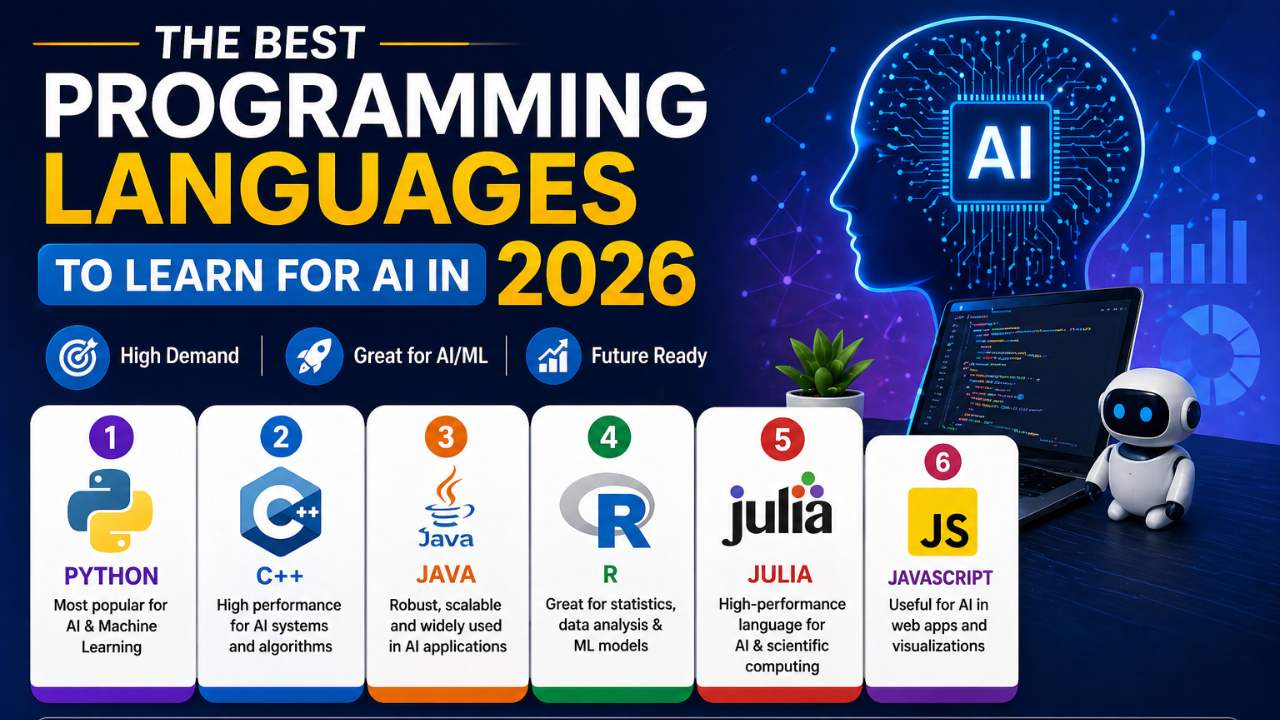
Python won the AI ecosystem and shows no sign of giving it up. Almost every major framework — PyTorch, TensorFlow, JAX, scikit-learn, Hugging Face Transformers, LangChain — is Python-first. The libraries are excellent, the community is huge, and the syntax is forgiving.
If you only ever learn one language for AI work, learn Python well. Not just the syntax — the ecosystem, the package management, the testing tools, the typing system that has matured significantly in recent years.
SQL: Not Optional
You will work with data. Most useful data lives in databases. SQL is the language used to query those databases. It is also surprisingly under-taught in AI courses. Learn enough SQL to write multi-table joins, window functions, and basic optimisation. This single skill noticeably accelerates careers.
JavaScript / TypeScript
Increasingly important for the application layer. The product engineering side of AI — chatbots, agents, copilots, internal tools — is largely built in TypeScript with frameworks like Next.js. If you want to ship user-facing AI products, learn it.
Many AI APIs also have first-class JavaScript SDKs, and tools like LangChain.js have made it possible to build serious applications without ever leaving the JS ecosystem.
C++ and CUDA
Necessary for the people writing the underlying frameworks and the highly optimised inference engines. Not necessary for almost anyone else. If you find yourself working on the performance frontier — custom kernels, low-level optimisation, model compression — these languages become essential. Otherwise, skip.
Rust
An interesting middle path. Some inference servers and tooling — including parts of the Hugging Face stack — are written in Rust. Rust is unlikely to displace Python for research, but it is increasingly relevant for production AI infrastructure.
Languages You Probably Do Not Need
- R — still used in academic statistics; rarely in modern AI work.
- Java — has ML libraries but is not where the field is.
- Julia — promising, beautiful, but the ecosystem never reached critical mass.
The Practical Order
- Become genuinely fluent in Python.
- Add SQL early. Within the first three months.
- Pick up TypeScript when you want to build user-facing applications.
- Learn C++ or Rust only if your job specifically requires them.
Polyglots impress at parties. In day-to-day AI work, depth in one or two languages beats shallow familiarity with five.
Follow on Facebook