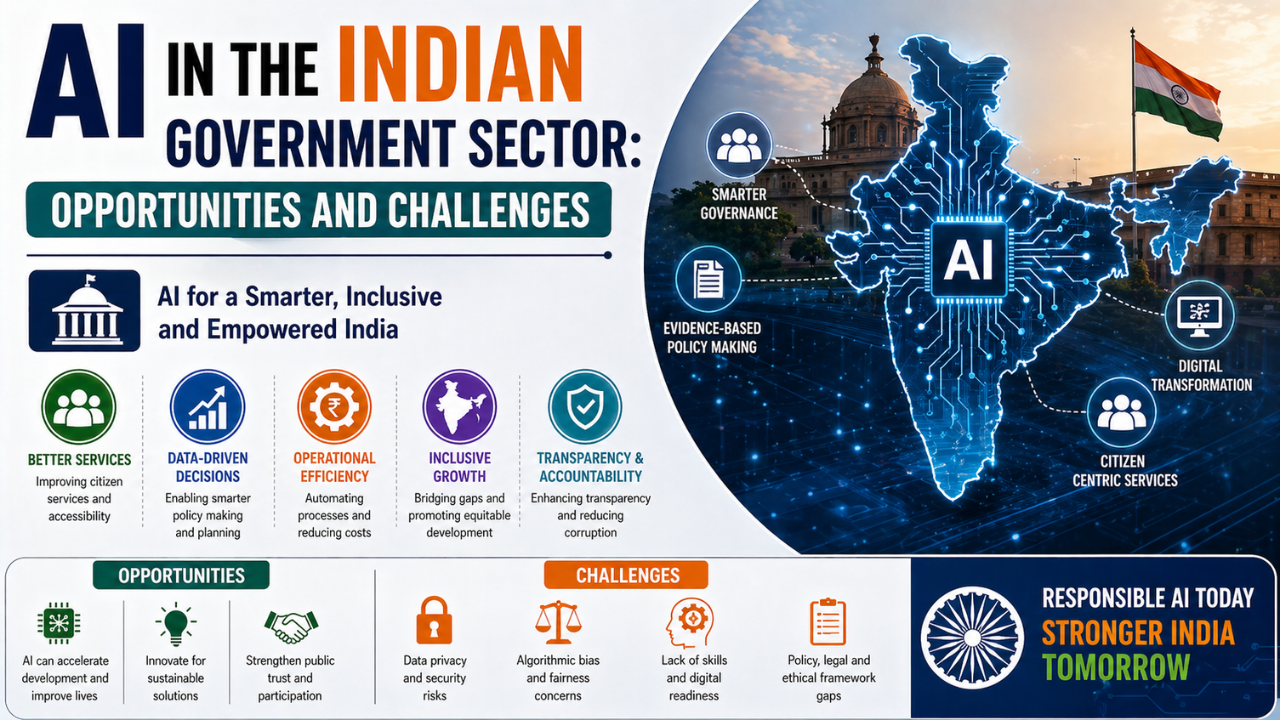
AI in the Indian Government Sector: Opportunities and Challenges. Public-sector AI in India is growing rapidly. A careful look at the opportunities, the realities, and what aspirants should actually prepare for.
The Indian government has, over the past few years, moved from cautious AI pilots to genuine deployments across welfare, agriculture, healthcare, justice, and defence. For students preparing for government careers, understanding this shift is no longer optional. This article maps the landscape as it stands today.
Where AI Is Actually Being Used
- Welfare delivery. Identifying eligible beneficiaries, detecting duplicate claims, and routing grievances.
- Agriculture. Crop yield estimation from satellite imagery, pest detection, and advisory chatbots in regional languages.
- Healthcare. Tuberculosis screening from chest X-rays, retinal disease detection, and AI-assisted diagnostics in district hospitals.
- Judiciary. Translation of judgments across Indian languages and assistance with case-law search.
- Tax and compliance. Anomaly detection in returns and risk-based audit selection.
- Urban governance. Traffic management, waste tracking, and water-quality monitoring in smart-city programmes.
The Institutional Landscape
Several organisations sit at the centre of public-sector AI work:
- NITI Aayog — strategy and the National AI Mission framework.
- MeitY — funding, infrastructure, and the IndiaAI portal.
- C-DAC — applied research and language-technology resources.
- NIC — government IT delivery, increasingly with AI components.
- State e-governance societies — implementation arms in each state.
Career entry points exist at all of these, ranging from competitive examinations to direct technical hiring.
Skills That Open Public-Sector Doors
- Strong fundamentals in machine learning and data engineering. The work is often less glamorous than private-sector research, but the foundations matter just as much.
- Familiarity with Indic-language NLP. Government datasets are deeply multilingual, and most off-the-shelf tooling assumes English.
- Awareness of data-privacy law. The Digital Personal Data Protection Act has reshaped what can and cannot be done with citizen data.
- Patience and process literacy. Government work moves more slowly than private-sector work, with more documentation and stricter procurement rules.
Honest Trade-offs
Public-sector AI work in India offers scale that almost no private project can match — a single deployment can affect millions of citizens. It also comes with constraints: slower decision cycles, lower compensation in most paths, and far more attention to process. Both sides are real. Choose with eyes open.
Pathways Worth Knowing
- UPSC Civil Services with a technology-aligned background — increasingly common among engineering graduates with policy interest.
- Direct recruitment in scientific and technical positions at C-DAC, ISRO, DRDO, and similar bodies.
- State data-officer and chief-data-officer roles — growing in number across state governments.
- Public-sector consulting — major firms have dedicated practice areas and recruit at all levels.
- Civic-tech non-profits — a path for those who want public-sector impact without being inside government.
What to Do This Year
If you are a student preparing for government roles and you want to be ready for the AI-shaped future of public administration, three actions matter most: build a real ML project in any domain (it does not have to be civic), read at least one major government AI report cover to cover, and become genuinely comfortable with at least one Indian language other than English in a technical context. None of these requires permission. All of them compound.
Follow on Facebook